

Israeli Prime Minister Benjamin Netanyahu on Sunday said Israel’s opposition to a Palestinian state “has not changed,” a day before the United Nations (U.N.) Security Council is set to vote on a U.S.-drafted resolution on Gaza that notes, following certain reforms, there may be “a credible pathway to Palestinian self-determination and statehood.”
Newsweek has reached out to the State Department for comment via email on Sunday.
Why It Matters
The U.S. has drafted a U.N. resolution that supports President Donald Trump’s Gaza peace plan and would authorize an International Stabilization Force in the territory. The draft also includes language backing Palestinian self-determination and the potential establishment of a Palestinian state, pending certain conditions. The resolution will go before the 15-member U.N. security council on Monday, nearly two weeks after U.S. Permanent Representative to the United Nations Mike Waltz presented a draft version.
The first phase of the Trump proposed deal focused on a ceasefire and exchange of Palestinian prisoners and Israeli hostages. The first steps came nearly two years after Hamas attacked Israel on October 7, 2023, killing around 1,200 people and taking around 250 hostages. Israeli then launched numerous ground and air offensives that killed more than 69,000 Palestinians, according to the Associated Press. Later phases of Trump’s plan focus on demilitarizing Gaza and deployment of stabilization forces.
Trump’s proposal marks the most substantial effort yet toward a lasting agreement between Israel and Hamas, after earlier deals yielded only temporary ceasefires.
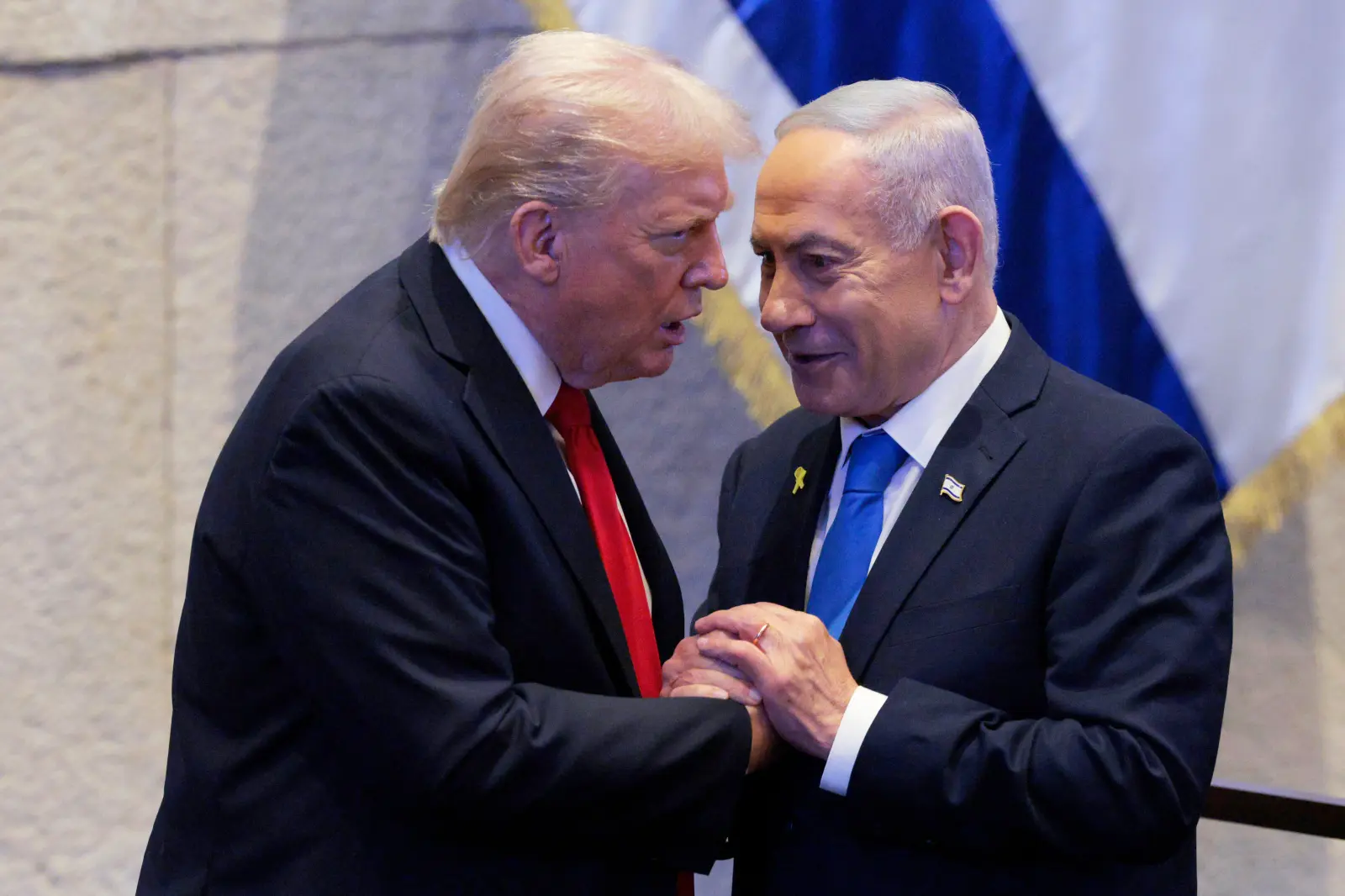
On Sunday, Netanyahu said during a government meeting, “Our opposition to a Palestinian state in any territory has not changed. Gaza will be demilitarized, and Hamas will be disarmed, the easy way or the hard way. I do not need affirmations, tweets, or lectures.”
He continued, that the country’s opposition “to a Palestinian state in any territory west of the Jordan River…is existing, valid, and has not changed one bit.”
Israel has long rejected the creation of a Palestinian state while expanding settlements across the territory, which many international community members consider illegally occupied. International pressure for Palestinian statehood has intensified during the Israel-Hamas war, with the United Kingdom, Australia and Canada all formally recognizing a Palestinian state in September. Over 150 nations recognize a Palestinian state.
Trump’s plan acknowledges the possibility of a Palestinian state in the future, but doesn’t guarantee it. It states that only after reform to the Palestinian Authority and Gaza reconstruction will there be “a credible pathway to Palestinian self-determination and statehood, which we recognize as the aspiration of the Palestinian people.” The details on the conditions and who would decide if they have been met are vague.
Critics say the proposal would give the Trump administration outsized control over Gaza’s political and security future, and doesn’t actually lend way to a Palestinian state. Strong supporters of Israel, meanwhile, argue the plan grants too much authority to a new Gaza governance structure and could weaken Israeli security.
The proposal also seeks to establish a “Board of Peace” to oversee the plan’s implementation, including the International Stabilization Force (ISF), as well as broad governance.
What People Are Saying
Israeli Defense Minister Israel Katz said in an X post in Hebrew Sunday: “Israel’s policy is clear: no Palestinian state will be established. The IDF will remain at the peak of Mount Hermon and in the security zone. Gaza will be de-fortified down to the last tunnel and Hamas will be disarmed in the yellow side by the IDF and in the old Gaza by the international force – or by the IDF.”
The Palestinian Youth Movement, a grassroots movement formed in response to the Oslo Accords, wrote in a Sunday X post: “We reject the American and imperialist attempt, through this UNSC resolution, to rehabilitate and further entrench the Zionist project in Palestine and across the Arab World. We call upon people of conscience everywhere to continue the struggle against this resolution and all that it represents.”
U.S. Secretary of State Marco Rubio said in an X post on November 14: “@POTUS’ historic Comprehensive Plan to End the Gaza Conflict is the best path to peace in the Middle East. Our UN Security Council Resolution will enable that plan and enjoys broad international and regional support. We are grateful to Qatar, Egypt, the UAE, Saudi Arabia, Indonesia, Pakistan, Jordan, and Türkiye for their endorsement. The Middle East has never been this close to a real and lasting peace.”
Francesca Albanese, United Nations Special Rapporteur on the Occupied Palestinian Territories, wrote in a November 12 X post: “Talk of drafting a Palestinian constitution sounds premature when the Palestinian people, and their future, risk being erased from what remains of their homeland. States must start by upholding the ICJ’s call to end Israel’s illegal occupation.”
U.S. Permanent Representative to the United Nations Mike Waltz wrote in the Washington Post on Friday: “Any refusal to back this resolution is a vote either for the continued reign of Hamas terrorists or for the return to war with Israel, condemning the region and its people to perpetual conflict. Every departure from this path, be it by those who wish to play political games or to relitigate the past, will come with a real human cost that can be measured in the number of lives lost.”
The Crisis Group said in an X post on November 15: “After many fruitless debates over Gaza since October 2023, UN Security Council members welcome the idea that they can play a role in ending the war. The draft U.S. resolution has, however, created many concerns.”
Craig Mokhiber, a human rights lawyer and former United Nations human rights official, said in a Saturday X post: “The US is pushing for a vote on the UN Security Council by Monday on the US-Israel colonial land grab in Gaza. The US draft would ignore the findings of the International Court of Justice and UN human rights bodies, violate key provisions of international law, reward and normalize the perpetrators of the genocide, punish the victims, consolidate the unlawful occupation, and further deny Palestinian self-determination. China and Russia (which has introduced an alternative draft) are so far holding firm against the US plot, and UNSC member Algeria is pushing for meaningful revisions. Sadly, several regional collaborators are supporting the US-Israel draft. Among them are non-members Qatar, Egypt, and the UAE, as well as Indonesia, and UNSC member Pakistan. This must be blocked. And the rest of the world must prepare to act in the UNGA on the Colombia proposal under Uniting for Peace to protect Palestinian human rights and hold the Israeli regime accountable.”
What Happens Next?
Russia, who is one of five permanent members that holds veto power in the Council, has proposed an alternative resolution that is more forward about Palestinian statehood. The U.S. proposal will go to vote on Monday.
